
Table of Contents
Breakwaters have long served as essential coastal protection structures, shielding harbors, ports, and shorelines from wave energy and erosion. Historically, their design focused on mass and durability, relying on rubble mounds or large concrete elements to absorb wave forces. As coastal environments face rising sea levels, stronger storms, and growing development pressure, breakwater design is evolving. Advances in engineering, materials, and digital analysis are redefining how these structures are planned, built, and maintained for long-term resilience.
The Shift Toward Modern Breakwater Engineering
Breakwater design has moved beyond static solutions toward systems that account for uncertainty and long-term change. Modern coastal engineering emphasizes performance under a wide range of conditions rather than reliance on historical wave data alone. This shift is driven by observed increases in storm intensity, changes in sediment transport patterns, and higher water levels that influence overtopping and structural stability. Contemporary design approaches focus on adaptable crest elevations, optimized slopes, and energy-dissipating profiles that perform reliably under variable wave climates while allowing for future modification.
Modular and Prefabricated Breakwater Systems
One of the most impactful innovations in breakwater construction is the growing use of modular and prefabricated components. Instead of building entirely in place, many projects now rely on precast concrete units or caissons manufactured in controlled environments and transported to the site for installation. This approach improves quality control, reduces construction time in exposed marine conditions, and minimizes weather-related delays. Field applications show that modular systems can achieve comparable hydraulic stability to traditional rubble mound designs while reducing on-site labor and improving consistency across large projects.
Advanced Armor Units and Concrete Technology
Armor units remain a critical element in breakwater design, but their geometry and material composition have changed significantly. Modern armor units are engineered to maximize interlocking performance and wave energy dissipation while reducing overall material use. Laboratory testing demonstrates that optimized unit shapes improve resistance to displacement, rocking, and settlement under wave loading. At the same time, advances in concrete technology, including high-performance and fiber-reinforced mixes, enhance durability against abrasion, chloride penetration, and long-term marine exposure.
Key Innovations in Modern Breakwater Design
|
Innovation Area |
Design Approach |
Primary Engineering Benefit |
Typical Applications |
|---|---|---|---|
|
Modular Construction |
Precast caissons and concrete units |
Faster installation and improved quality control |
Ports, harbors, exposed coastlines |
|
Advanced Armor Units |
Optimized interlocking concrete shapes |
Increased wave energy dissipation with less material |
Rubble mound breakwaters |
|
Floating Systems |
Mooring-based floating structures |
Effective wave reduction without seabed disturbance |
Marinas, sheltered waters |
|
Energy-Integrated Designs |
Overtopping and wave interaction systems |
Renewable energy generation with coastal protection |
Port breakwaters |
|
Ecological Enhancements |
Textured surfaces and habitat features |
Improved biodiversity and shoreline resilience |
Urban and natural shorelines |
|
Digital Modeling |
Numerical and physical simulations |
Reduced uncertainty and optimized design |
All breakwater types |
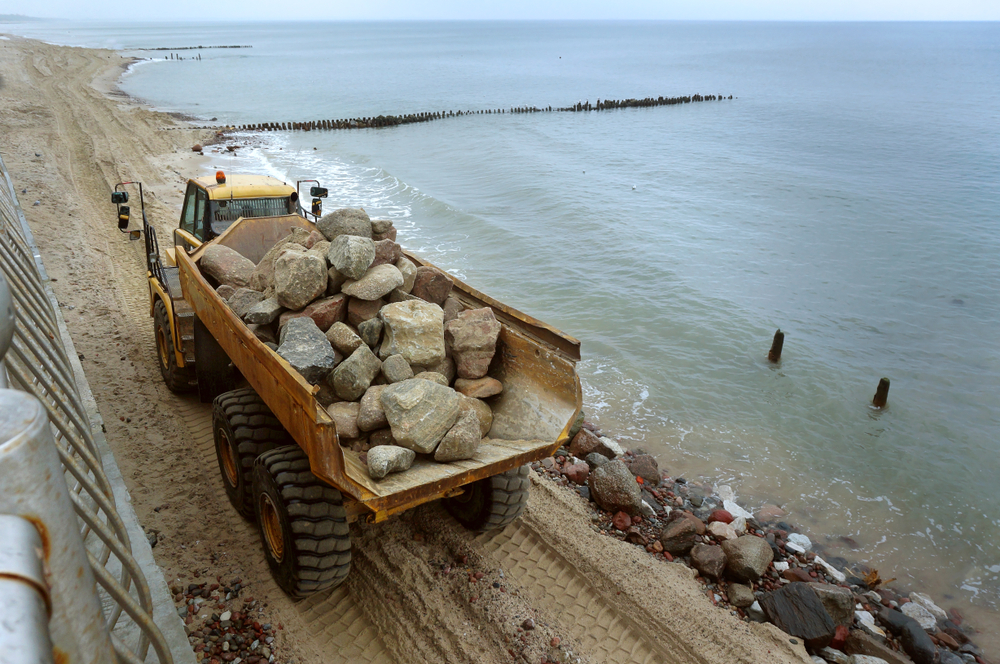
Modular and prefabricated breakwater systems shorten construction time and improve quality control in marine environments. Field use shows they can perform similarly to traditional rubble mound structures when properly designed.
Floating and Hybrid Breakwater Solutions
Floating breakwaters are increasingly used where seabed conditions, water depth, or environmental constraints limit the feasibility of fixed structures. These systems are commonly applied in marinas, sheltered harbors, and coastal developments where wave conditions are moderate. Modern floating breakwaters use advanced mooring configurations and energy-dissipating geometries to reduce wave transmission. Hybrid configurations that combine floating elements with submerged components are being explored to extend performance to more exposed locations.
Integrating Renewable Energy into Breakwaters
Breakwaters are increasingly viewed as multifunctional infrastructure rather than single-purpose structures. One area of innovation involves integrating wave energy conversion systems directly into breakwater designs. Overtopping-based systems capture water that flows over the crest during wave action and convert it into electricity using low-head turbines. Monitoring from operational installations indicates that these systems can generate renewable energy while preserving the protective function of the breakwater.
Living and Ecological Breakwater Concepts
Environmental performance has become a central consideration in modern breakwater design. Living breakwaters aim to reduce wave energy while supporting marine ecosystems and improving shoreline resilience. These designs incorporate textured surfaces, habitat-forming geometries, and ecologically enhanced concrete to encourage marine life colonization. Field observations show that ecological features can increase biodiversity without compromising structural performance when integrated into the engineering design from the outset.
Digital Modeling and Simulation in Breakwater Design
Digital tools now play a central role in breakwater engineering. Numerical wave models, computational fluid dynamics, and advanced simulation techniques allow engineers to evaluate wave-structure interaction, sediment transport, and structural response before construction begins. By testing thousands of scenarios digitally, designers can reduce uncertainty, avoid overdesign, and improve lifecycle planning for long-term performance and maintenance.
Sustainable Materials and Low-Carbon Construction Methods
Sustainability considerations are increasingly influencing material selection and construction practices in coastal projects. Low-carbon concrete mixes, recycled aggregates, and supplementary cementitious materials are being incorporated into breakwater construction to reduce embodied carbon. Long-term exposure studies indicate that these materials can perform effectively in marine environments when properly designed, offering durability comparable to traditional materials while lowering environmental impact.
Modular Design, Energy, and Ecology
Modern breakwater innovation increasingly combines modular construction, renewable energy integration, and ecological enhancement into unified systems. This integrated approach reflects a broader shift in coastal engineering toward infrastructure that delivers protection, sustainability, and adaptability simultaneously, rather than addressing each objective in isolation.
The Future of Breakwater Design
The future of breakwater design lies in performance-based engineering, adaptability, and closer integration with natural systems. As coastal risks continue to evolve, breakwaters will increasingly function as multifunctional assets that support shoreline protection, renewable energy generation, and ecosystem resilience. Ongoing research, monitoring, and technological development will continue to shape how coastal construction responds to these challenges.